
Figure Out Pool Volume
Last updated 15 October 2026
Enter waterline dimensions and depth to get pool volume in gallons, litres and cubic metres.
Your result will appear here
Enter your measurements, then choose Calculate.
Use the water volume for circulation and heating calculations.
Still unknown or unconfirmed
Formula, sources and blank printable worksheet
VOL-1: area × water depth; add non-overlapping sections. US gallons = ft³ × 1728/231. L = m³ × 1000.
Calculation version 1.0 uses historical engineering references for arithmetic, not current residential law.
- Sta-Rite Engineering and Design Manual, second edition, 2003, printed pp. 2, 27, 29, 36-40, 44 https://www.pentair.com/content/dam/extranet/nam/pentair-pool/residential/manuals/training/Sta-Rite%20Engineering%20and%20Design%20Manual.pdf
- NIST Handbook 44, Appendix C: US gallon and length units https://www.nist.gov/system/files/documents/2019/11/19/00-20-hb44-final11152019pdf.pdf
| Quantity / unit | Reading | Source and date |
|---|---|---|
| Water outline | ________________ | ________________ |
| Length unit | ________________ | ________________ |
| Waterline length | ________________ | ________________ |
| Waterline width | ________________ | ________________ |
| Waterline diameter | ________________ | ________________ |
| Measured water-surface area | ________________ | ________________ |
| Area unit | ________________ | ________________ |
| Water volume | ________________ | ________________ |
| Volume unit | ________________ | ________________ |
| Floor measurement | ________________ | ________________ |
| Water depth / known average | ________________ | ________________ |
| Shallow water depth | ________________ | ________________ |
| Deep water depth | ________________ | ________________ |
Mark missing measurements Unknown. Keep exact model, source revision and assumptions with this worksheet. Report a calculation or source correction with reproducible inputs.
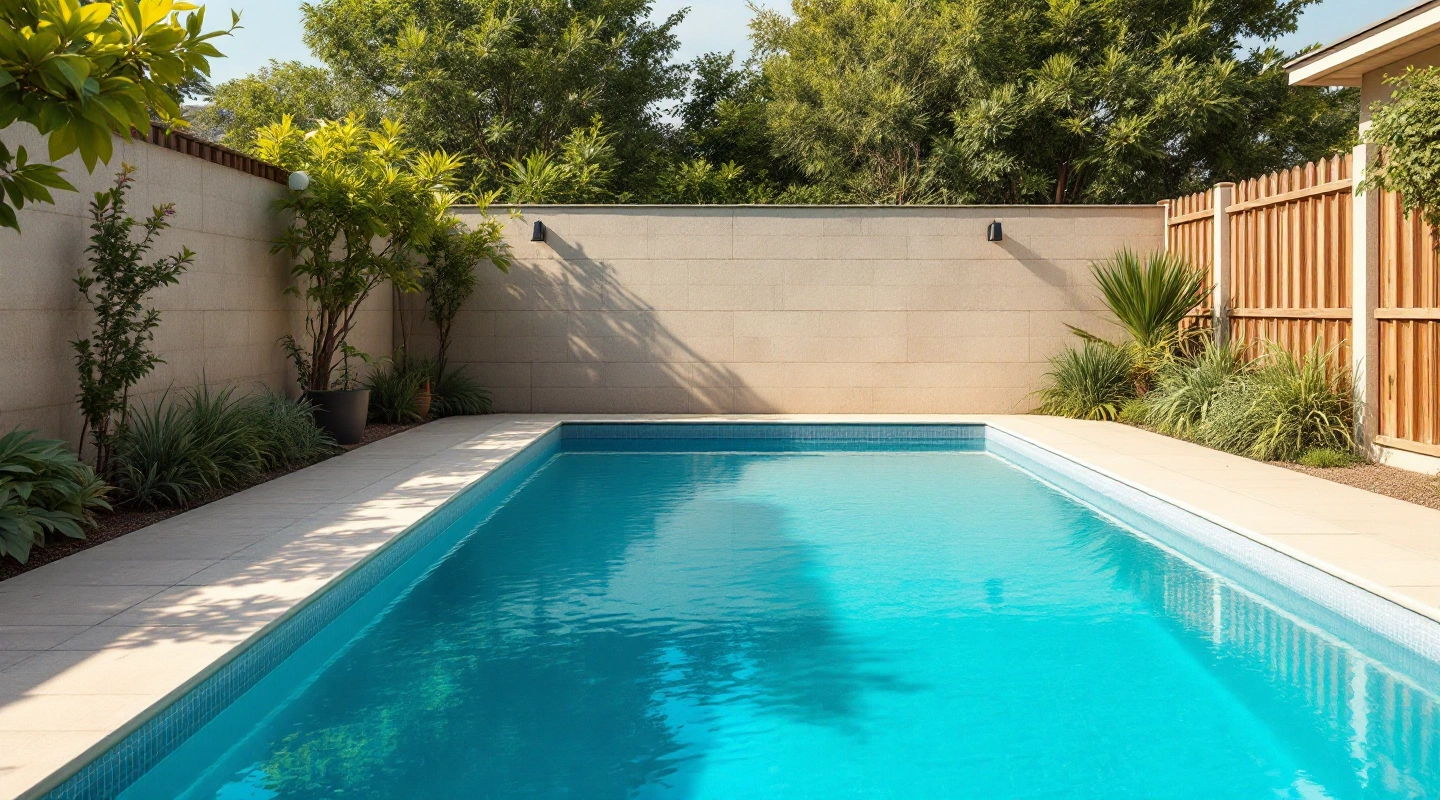
To figure out pool volume, measure the water inside the pool. A size printed on a box may describe its outside frame. Use the shape and floor that match the water you have, then keep the units with the result.
Multiply water-surface area by average water depth. For a floor that slopes at a steady rate, average its two end depths. Split a floor with steps or a change in slope into separate sections. Results include US gallons and litres, with cubic volume shown too. Irregular pools need measured area or section measurements, rather than a fixed kidney-pool factor.
On this page8
Figure out pool volume from water dimensions
Measure length and width at the normal waterline. Measure water depth from that line to the floor, not from the deck. Measurements accept feet or inches. Metres and centimetres work too. Changing units converts the existing measurements; it must not turn a 32-foot pool into a 32-metre pool.
Choose the rectangle or circle option only when it fits the outline. The ellipse option needs a true ellipse. A pool sold as oval may have straight sides and round ends. In that case, measure separate sections. A known surveyed surface area can also be used with a measured average depth.
Pool volume formulas and units
| Water outline | Area before multiplying by depth |
|---|---|
| Rectangle | Length × width |
| Circle | π × diameter² ÷ 4 |
| True ellipse | π × full length × full width ÷ 4 |
| Measured surface | Enter the measured area |
Multiply square feet by feet to get cubic feet. Multiply square metres by metres to get cubic metres. There are 1,000 litres in a cubic metre. For US gallons, multiply cubic feet by 1,728 ÷ 231, about 7.48052. The gallon definition comes from NIST Handbook 44, Appendix C.
The Sta-Rite engineering manual, printed page 2 describes the section method. Its rounded 7.5-gallon factor is useful for rough work. This calculator uses the more exact unit conversion. That precision does not make a rough tape measurement exact.
Sloping floors and separate sections
For one rectangular section with a steady slope, average depth is shallow depth plus deep depth, divided by two. A flat floor uses the same depth at both ends. Give a hopper its own area and depth. Measure ledges and steps as separate sections too.
Add each section's volume. Do not average the depths of unequal sections without weighting them by area. Do not count overlapping sections twice. Record any curved corners or benches that your sections leave out. Their effect remains an estimate until measured.
Worked 32-by-16-foot example
A rectangular water surface measures 32 by 16 feet. Its floor slopes evenly from 3 to 6 feet. Average depth is 4.5 feet. The result is 512 square feet × 4.5 feet = 2,304 cubic feet, or about 17,235 US gallons and 65,242 litres.
Those are calculated figures for a stated shape. Rounded corners, steps and a different fill level will alter the real volume. Save the measurements with the answer so you can revise them later.
Use the measured volume
Take the result to the pool pump size calculator, the fill-time calculator or the heater calculator. Use surface area when the task concerns exposed water rather than gallons. The runtime tool also needs actual flow.
FAQ
Can I use the pool's advertised size?
Treat the nominal pool size as an initial estimate of water volume. Water dimensions can differ from frame dimensions. The normal fill level also matters. Record the length and width at the waterline. Keep floor depths with those measurements and note any sections left out.
Is a kidney-shaped pool an ellipse?
Usually its outline needs a different method. Enter a measured water-surface area or add non-overlapping measured sections. A fixed kidney multiplier hides the uncertainty. Keep a sketch of the sections with the saved result so another measurement can use the same boundaries.
Related calculations and owner guides
Verdict on pool volume
Figure out pool volume from the waterline and floor you can measure. Keep a section sketch with the result. Save the units beside each assumption. Version 1.0 follows NIST units and the cited engineering geometry. Send a reproducible correction through contact.